1 · Applications
Where people work with AI: workplace assistants, AI inside business applications, dedicated agents for a process. This is where value is created and measured.

Insights · AI architecture
Many companies now run a dozen AI tools, each with its own data access and its own rules. A reference architecture brings order: what belongs in which layer, and what is built once and used by everyone?
By Michele Mangieri · Updated
In short
An AI reference architecture is a frame that sets out what belongs in which layer and what is built once and used by everyone. It describes six layers: applications, orchestration, knowledge and meaning, data and systems, models, and cross-cutting governance and security. The layers describe capabilities, not products.
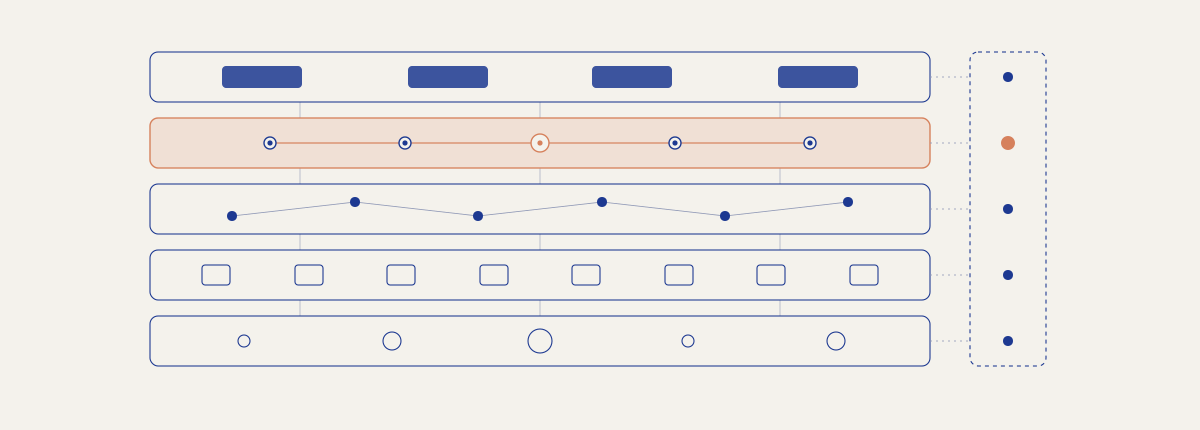
Six layers
The layers describe capabilities, not products. Which solution fills a layer is a later decision.
Where people work with AI: workplace assistants, AI inside business applications, dedicated agents for a process. This is where value is created and measured.
The multi-agent platform assigns tasks to specialised agents, combines their results and obtains approvals. More in the next section.
Searchable documents, a glossary, metrics with fixed definitions and the relationships between business objects. This layer makes answers correct, not the model.
ERP, CRM, procurement, document storage, data platform. Connected through interfaces with clear agreements, not through clicks on the user interface.
Large and small language models, image and speech models, classic predictive models. Connected through one access layer and replaceable.
Identities and permissions, logging, cost control, quality measurement and classification under the EU AI Act. Applies to every layer and is built once.
Multi-agent platform (MAP)
As soon as more than two or three agents are in use, a shared platform is needed. Otherwise every team rebuilds access, approvals and logging. A MAP bundles six capabilities:
Start from business capabilities
We do not start with the tool but with the company’s capability map: which capability gains most from AI, and what does it need from the layers below?
Bundle demand, assess suppliers, review contracts. A detailed example is in AI in procurement.
Classify enquiries, prepare quotes, answer customer questions from knowledge and contract data.
Check invoices, explain variances, prepare closing tasks.
Answer policy questions, support onboarding, match profiles and requirements.
What several capabilities need belongs in the shared layers: the same permission check, the same glossary, the same platform for agents. Each new use case then builds on the foundations instead of creating another island.
What matters
We have worked on enterprise architecture since 2007 and use AI agents ourselves (AI in practice). We use the reference architecture as common ground between business and IT: the business brings the capability, IT brings the layers. What this requires on the data side is covered in Chat with your own data.
Want to bring your AI initiatives into one common frame? AI Decision Readiness →
Frequently asked questions
The layer that turns single agents into a system. It assigns tasks to specialised agents, combines their results and obtains approvals. It is needed as soon as more than two or three agents are in use; otherwise every team rebuilds access, approvals and logging.
They are open standards that keep controlled access replaceable: MCP for connecting systems, A2A for coordination between agents. Agents reach systems and tools only through approved interfaces and with their own identity.
With the company's capability map, not with the tool: which capability gains most from AI, and what does it need from the layers below? The first work step is comparing the architecture with your own landscape: what exists, what is missing, what is duplicated?
In the cross-cutting layer for governance and security. The EU AI Act classifies AI systems by risk, and this layer records which use case falls into which class.
You describe the decision ahead. We tell you which package fits, or that none does.