Capture and bundle demand
Assign free-text requests to a material group or catalogue item and spot identical demand across sites.

Insights · AI architecture
Procurement is a good first business area for AI agents: many recurring steps, many documents, clear rules and measurable results. What matters is aligning the agents with procurement capabilities, not with a tool.
By Michele Mangieri · Updated
In short
AI in procurement means aligning AI agents with procurement capabilities, not with a tool. Procurement is a good first business area for AI agents: many recurring steps, many documents, clear rules and measurable results. The agents prepare, the buyer decides.
Procurement capabilities
Assign free-text requests to a material group or catalogue item and spot identical demand across sites.
Combine supplier master data, performance data and public information, and surface risks such as dependencies or late deliveries early.
Create requests from templates, make differently formatted quotes comparable and flag deviations.
Check clauses against your own standards and keep an eye on deadlines and price adjustments.
Prepare purchase orders, match invoices against order and goods receipt, and explain variances.
An example
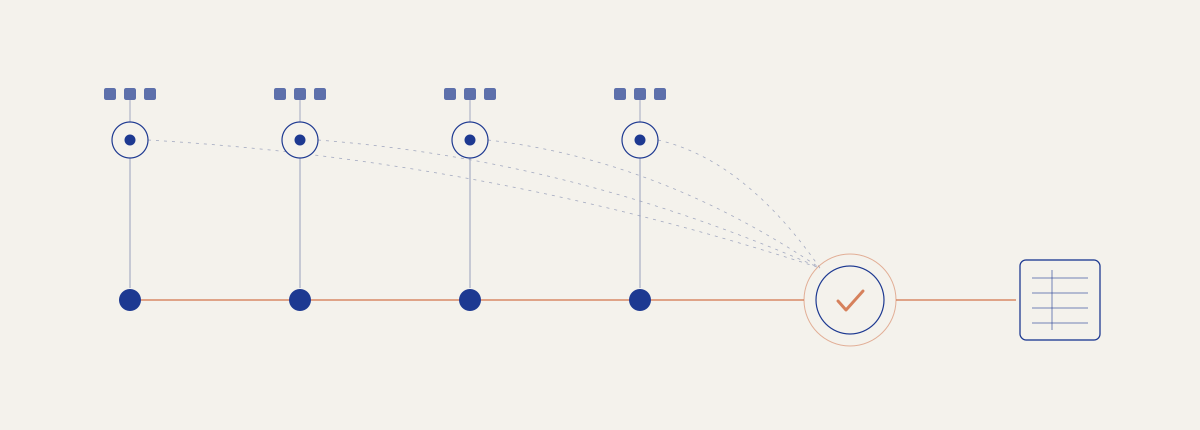
This is how a flow on a multi-agent platform can look when a business unit reports a new demand:
The agents prepare, the buyer decides. Every step is logged and traceable.
What must be right first
What matters
We have supported procurement processes and their interfaces in ERP projects, from open purchase orders during migration to electronic data interchange with suppliers (EDI in S/4HANA projects). How procurement fits into an overall architecture is covered in AI reference architecture.
Want to find out where AI has the biggest lever in your procurement? AI Decision Readiness →
Frequently asked questions
In five capabilities: capturing and bundling demand, finding and assessing suppliers, tendering and comparing, reviewing contracts, and from order to invoice. AI can, for example, assign free-text requests to a material group, flag deviations or match invoices against order and goods receipt.
On a multi-agent platform, for example: a demand agent assigns a material group, a supplier agent proposes suppliers, a risk agent checks dependencies and credit standing, and a contract agent compares terms. The purchase order is created in the ERP only after the buyer approves.
Clean procurement data: suppliers without duplicates, materials with a material group, one shared material group structure across all sites, digital and findable framework agreements, and written rules such as value limits and approval levels. Plus documented ERP interfaces with a separate identity for each agent.
With a measurable case. Pick a bottleneck, for example the time from request to purchase order or the share of invoices with variances, and measure it first. Without a baseline, no benefit can be proven.
You describe the decision ahead. We tell you which package fits, or that none does.