Documents: find the passages
Policies, contracts, manuals, tickets. The AI retrieves the relevant passages and writes an answer from them, citing the source. The technical term is retrieval-augmented generation (RAG).

Insights · AI architecture
Ask a question in plain language and get an answer from your own systems, with sources: a language model cannot do this on its own. It takes clear questions, data that can be found, agreed definitions and permissions that carry through to the answer.
By Michele Mangieri · Updated
In short
Chatting with your own data means asking a question in plain language and getting an answer from your own systems, with sources. A language model cannot do this on its own. It takes clear questions, data that can be found, agreed definitions and permissions that carry through to the answer. Documents and figures need different paths.
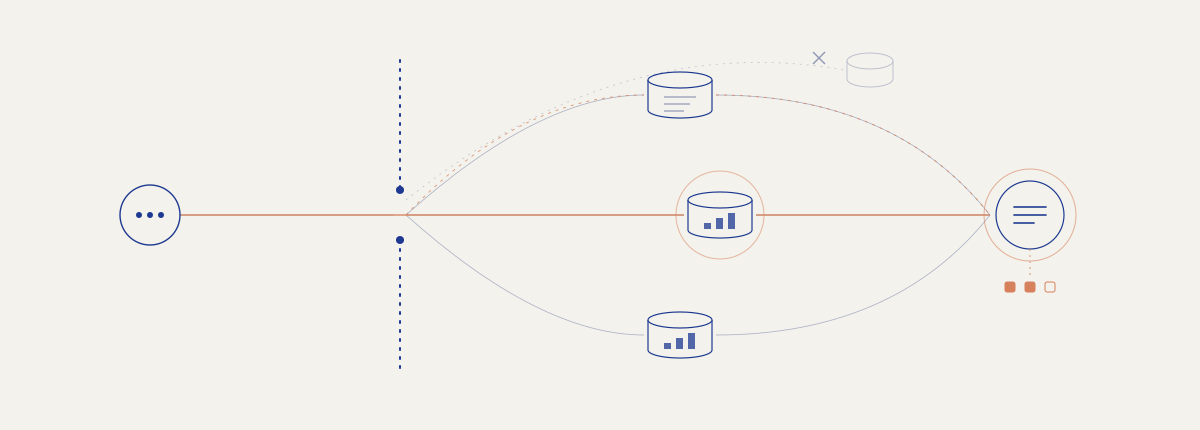
Two kinds of data
Policies, contracts, manuals, tickets. The AI retrieves the relevant passages and writes an answer from them, citing the source. The technical term is retrieval-augmented generation (RAG).
Revenue, stock levels, delivery dates from ERP, CRM or a data platform. The AI translates the question into a query on approved metrics and does not calculate on its own. Every result stays verifiable.
Many real questions mix the two, for example: “Which suppliers with a framework agreement are behind on delivery dates?” An orchestration layer splits the question into parts and combines the answers.
Eight steps
What Gartner expects
AI-ready data does not mean “as much data as possible”. It means data whose origin, meaning and quality are proven for the specific use case.
Source: Gartner, press release “Lack of AI-Ready Data Puts AI Projects at Risk”, 26 February 2025, including a survey of around 1,200 data management leaders. Gartner is a registered trademark of Gartner, Inc. and/or its affiliates.
What matters
How the data chat fits into an overall architecture is covered in AI reference architecture. An example from one business area: AI in procurement. How AI is connected to your systems is explained in MCP server explained simply.
Want to know whether your data is ready for an AI chat? AI Decision Readiness →
Frequently asked questions
Through retrieval-augmented generation (RAG). The AI retrieves the relevant passages from policies, contracts, manuals or tickets and writes an answer from them, citing the source.
No. The AI translates the question into a query on approved metrics and does not calculate on its own, so every result stays verifiable. When a question mixes documents and figures, an orchestration layer splits it into parts and combines the answers.
Start small: one business area, one group of questions, a few sources. Twenty real questions from the business are the best starting point. They later become the test bench on which business experts rate the answers before a wide rollout.
Not as much data as possible, but data whose origin, meaning and quality are proven for the specific use case. Gartner expects 60% of AI projects without AI-ready data to be abandoned through 2026.
You describe the decision ahead. We tell you which package fits, or that none does.