Today: copy and paste
Employees copy figures from the ERP or passages from contracts into the AI chat. It takes time, causes errors, and nobody knows which data went where.

Insights · AI architecture
AI assistants know a lot about the world, but nothing about your orders, contracts and customers. An MCP server is the connection through which they get this data, under control. What it is, what it brings and what you should decide before anyone builds.
By Michele Mangieri · Updated
In short
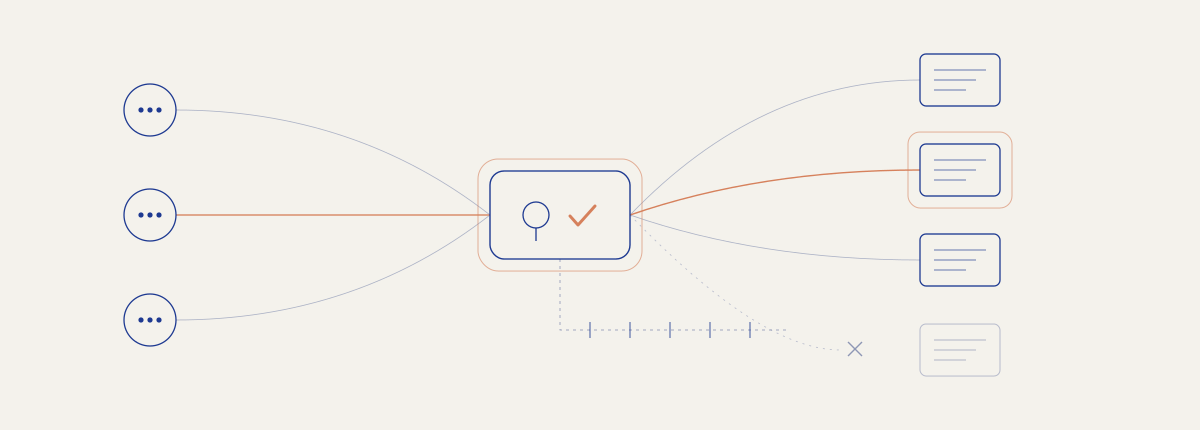
An MCP server is the connection through which AI assistants get data from your own systems, under control. As an open standard, the Model Context Protocol (MCP) works like a power socket: built once, it fits different AI assistants. As at a reception desk, whoever asks is identified, gets only what they may see, and every visit is logged.
The picture behind it
Employees copy figures from the ERP or passages from contracts into the AI chat. It takes time, causes errors, and nobody knows which data went where.
The AI asks for itself, but only through one entrance. Like the reception desk of a company: whoever asks is identified, gets only what they may see, and every visit is logged.
MCP stands for Model Context Protocol, an open standard. It works like a standard power socket: built once, the connection fits different AI assistants, such as Claude, ChatGPT or Microsoft Copilot.
What it brings day to day
With a connection, the AI answers questions from your own systems and says where the answer comes from:
Five decisions
The business answers these questions, not IT. The technology follows from them.
Which AI behind it?
The connection does not depend on which AI model answers the questions. That is its real advantage: you can change the model without rebuilding.
The well-known AI assistants, paid by subscription or usage. They are the most capable. Data is processed by the provider, governed by contract and partly in EU data centres.
Providers based in the EU with EU data centres. Relevant when processing in Europe is mandatory.
Freely available models, run in your own data centre or with a German cloud provider. Data does not leave the company. This needs your own computing power, and these models are often weaker on difficult tasks.
What matters when choosing: does the model work reliably with the connection? Test that with your own questions, not with rankings from the internet.
What matters
What should be clear about your data before connecting is covered in Chat with your own data. Where the connection sits in the bigger picture is shown in the AI reference architecture.
Want to know which of your systems could be connected first? AI Decision Readiness →
Frequently asked questions
Different ones, such as Claude, ChatGPT or Microsoft Copilot, because MCP is an open standard. Which assistants can use the connection also depends on where it runs, because some services connect from their own cloud.
Five questions, answered by the business rather than IT: which questions come first, read only or also act, who may see what, where the connection runs and who is responsible. The technology follows from them.
We recommend starting with reading. If the AI is later allowed to create or change something, a person approves first. Permissions stay as they are: a buyer sees no more through the AI than in the ERP.
The connection does not depend on the model, so you can change it without rebuilding. The options are large providers as a service, European providers or open models run yourself. Test whether a model works reliably with the connection using your own questions.
You describe the decision ahead. We tell you which package fits, or that none does.