Assistant
Answers questions and drafts texts. Every answer needs a new request; nothing is acted on.

Insights · AI
AI agents plan steps, use tools and complete tasks on their own. That promises a lot and often fails at the same points: unclear value, missing interfaces, no rules for approvals.
By Michele Mangieri · Updated
In short
Agentic AI refers to AI agents that do not just answer but act: they receive a goal instead of a question, plan the steps, call systems and tools and check interim results themselves. That sets them apart from assistants, which answer questions. Projects often fail at the same points: unclear value, missing interfaces and no rules for approvals.
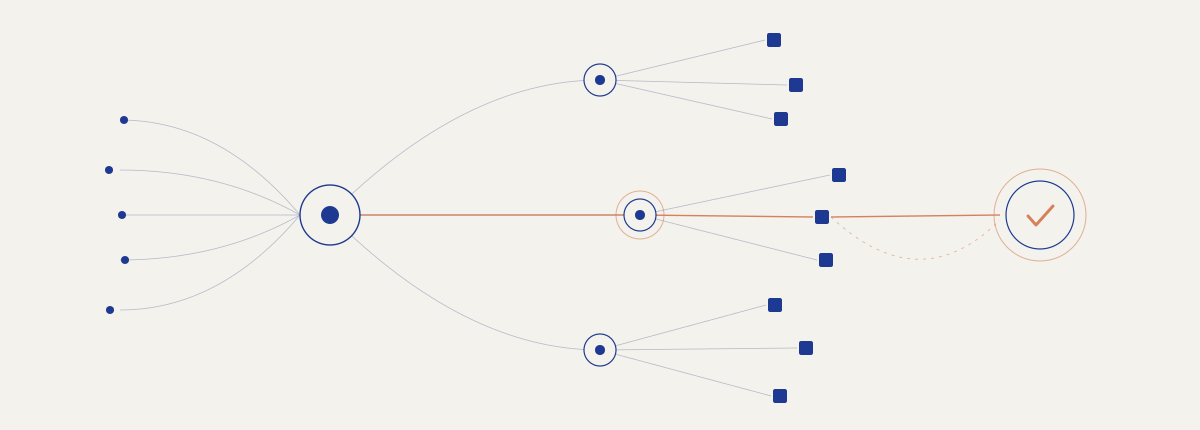
From chatbot to agent
Answers questions and drafts texts. Every answer needs a new request; nothing is acted on.
Works directly inside an application, such as Microsoft 365 Copilot or SAP Joule, and makes suggestions. Whether a suggestion is applied is up to a person.
Receives a goal instead of a question. Plans the steps, calls systems and tools and checks interim results itself.
Several specialised agents share one task. A control unit distributes the work and brings the results together.
What Gartner expects
Gartner names rising costs, unclear business value and inadequate risk controls as reasons for the cancellations. On top of that comes “agent washing”: vendors rebrand chatbots and conventional automation as agents. Of thousands of vendors, Gartner says only around 130 offer genuine agentic features.
Source: Gartner, predictions on agentic AI, most recently in the press release of 25 June 2025. Gartner is a registered trademark of Gartner, Inc. and/or its affiliates.
What matters
We work AI first and use various AI agents ourselves, for example with Claude Code. Our rule: the agent assists, the responsibility stays with people. The fundamentals teams need for this are covered in AI literacy. How agents fit into an overall architecture is covered in AI reference architecture.
Wondering where AI agents could add value for you? AI Decision Readiness →
Frequently asked questions
An assistant answers questions and drafts texts, but nothing is acted on. An agent receives a goal, plans the steps, calls systems and tools and checks interim results itself. In between sits the embedded assistant, which makes suggestions inside an application.
Gartner names rising costs, unclear business value and inadequate risk controls. It expects over 40% of agentic AI projects to be cancelled by the end of 2027. On top of that comes agent washing: vendors rebranding chatbots and conventional automation as agents.
A landscape they can work in: a measurable case, stable APIs and clean master data, their own identity with narrow rights and logged actions, and approvals by risk for anything touching money, contracts or customer data.
Standards that define how agents address tools and other agents. MCP stands for Model Context Protocol, A2A for Agent2Agent. For this, agents need interfaces instead of screen clicks, meaning stable APIs, along with clean master data.
You describe the decision ahead. We tell you which package fits, or that none does.